
Getting traffic is exciting.
Seeing thousands of visitors land on your website feels like progress. But here’s the uncomfortable truth:
Traffic doesn’t pay the bills. Conversions do.
You can double your traffic and still struggle with revenue if your website isn’t optimized. That’s where conversion rate optimization (CRO) becomes the most powerful growth lever in digital marketing.
In this guide, we’ll break down what CRO really means, why it’s critical for scalable growth, and how to build a CRO strategy that consistently turns traffic into revenue.
What Is Conversion Rate Optimization?
Conversion Rate Optimization (CRO) is the process of improving your website or landing pages to increase the percentage of visitors who take a desired action.
That action could be:
- Filling out a form
- Booking a consultation
- Purchasing a product
- Downloading a guide
- Subscribing to a newsletter
If 1,000 visitors land on your page and 20 convert, your conversion rate is 2%.
CRO focuses on increasing that percentage without increasing traffic.
Why CRO Is the Most Underrated Growth Strategy
Most businesses try to solve revenue problems by increasing traffic.
But consider this:
- 1,000 visitors at 2% conversion = 20 leads
- 1,000 visitors at 4% conversion = 40 leads
You just doubled results without spending more on ads.
CRO improves:
- Return on ad spend
- Customer acquisition cost
- Funnel efficiency
- Revenue predictability
It’s one of the most cost-effective growth strategies available.
The Real Goal of CRO
Many people misunderstand conversion rate optimization.
It’s not about manipulating users.
It’s about removing friction.
CRO improves:
- Clarity
- Trust
- Simplicity
- Speed
- Relevance
When visitors clearly understand your value and experience a seamless journey, conversions naturally increase.
The 6 Core Elements of a Strong CRO Strategy
1️⃣ Clear Value Proposition
Your headline is the most important part of your page.
Visitors should instantly understand:
- What you offer
- Who it’s for
- Why it matters
If your message is vague, conversions drop.
Strong CRO strategy starts with clarity.
2️⃣ Focused Call-to-Action (CTA)
Too many CTAs create confusion.
A high-converting page focuses on one primary action.
Effective CTAs are:
- Clear
- Action-driven
- Benefit-oriented
- Visually distinct
Examples:
- “Start Your Strategy”
- “Get a Free Audit”
- “Book Your Consultation”
Your CTA must stand out visually and psychologically.
3️⃣ Social Proof and Trust Signals
People convert when they feel safe.
Trust signals include:
- Testimonials
- Case studies
- Reviews
- Certifications
- Secure payment indicators
Social proof reduces hesitation.
Without trust, traffic leaks away.
4️⃣ Optimized Page Structure
Your layout must guide attention.
Effective structure includes:
- Logical content flow
- Proper spacing
- Readable typography
- Clear hierarchy
- Minimal distractions
Clutter kills conversions.
Simplicity converts.
5️⃣ Speed and Technical Performance
Page load time directly impacts conversions.
A delay of even a few seconds can reduce performance dramatically.
Technical optimization includes:
- Image compression
- Clean code
- Mobile responsiveness
- Fast hosting
- Script minimization
CRO is not just design — it’s performance engineering.
6️⃣ Continuous Testing and Optimization
CRO is not a one-time fix.
It requires:
- A/B testing
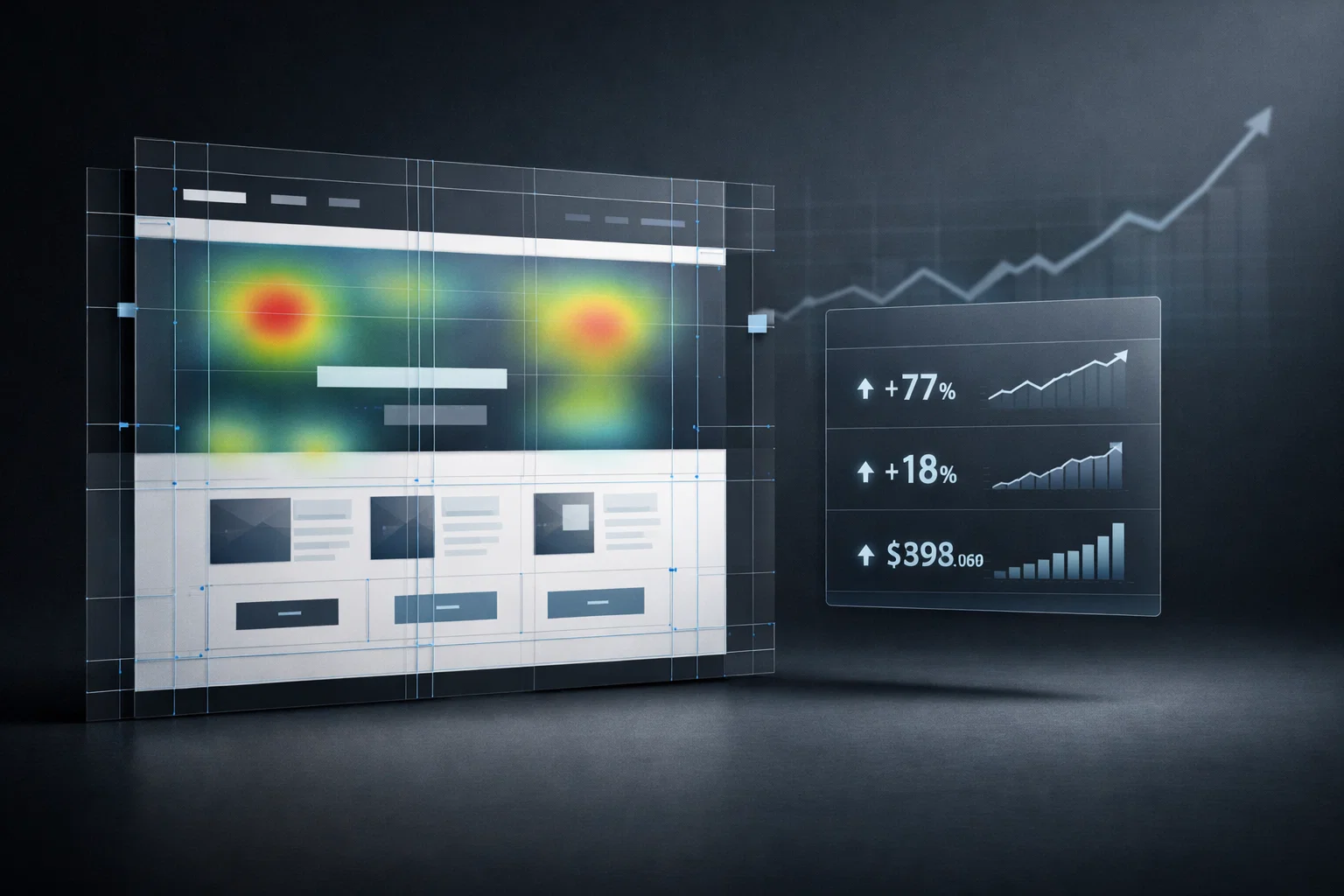
- Heatmap analysis
- Funnel tracking
- User behavior analysis
- Data-driven iteration
Small improvements compound.
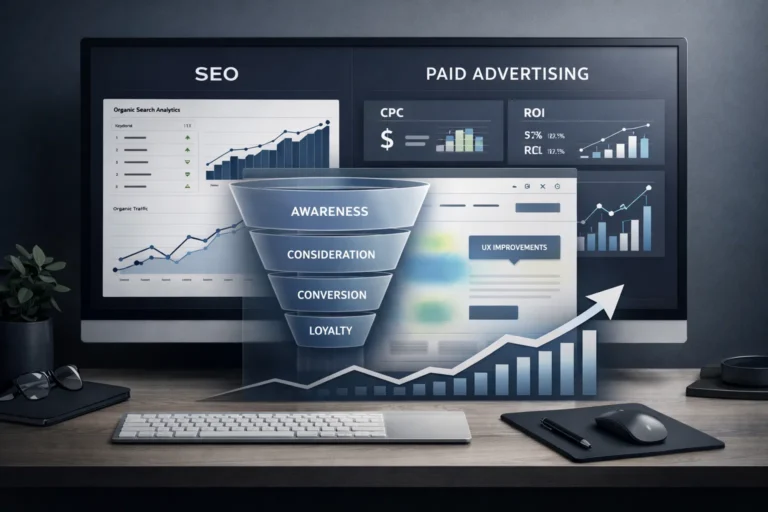
How CRO Works Inside a Marketing Funnel
Conversion rate optimization doesn’t only apply to landing pages.
It applies to every stage of your funnel:
- Ad creative
- Email subject lines
- Lead magnets
- Checkout pages
- Thank-you pages
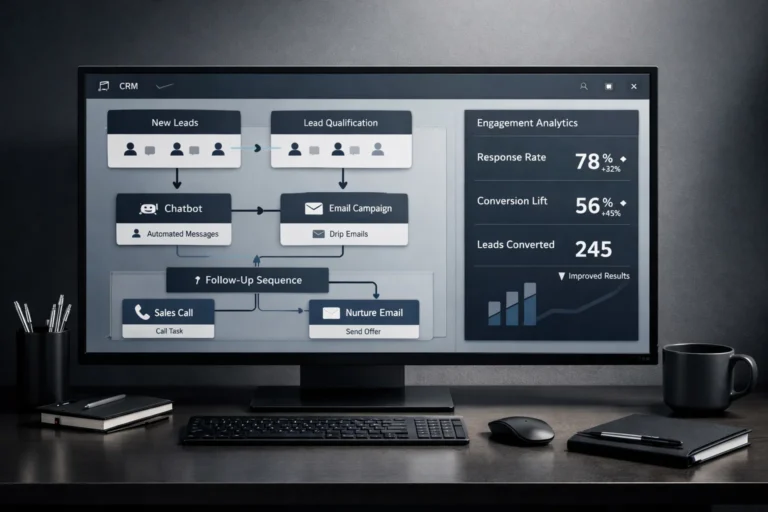
- Follow-up sequences
High-performance marketing integrates CRO across the entire system.
If you are building a structured growth framework, reviewing comprehensive digital services can help you understand how CRO fits into a broader performance strategy.
Common Conversion Killers
Here are some frequent issues that hurt conversions:
❌ Slow page speed
❌ Weak headline clarity
❌ Too many form fields
❌ Poor mobile optimization
❌ No social proof
❌ Complicated checkout process
❌ Generic messaging
Sometimes improving conversions is about fixing small details.
The Psychology Behind High-Converting Pages
Conversion rate optimization is deeply connected to human behavior.
Visitors ask themselves:
- Is this relevant to me?
- Can I trust this?
- Is this worth my time?
- Is this safe?
- Is this easy?
Your page must answer these questions clearly.
Emotion + clarity = action.
Data-Driven CRO: Where AI Comes In
Modern CRO strategies use AI to:
- Identify drop-off points
- Predict high-converting variations
- Personalize landing pages
- Analyze behavioral patterns
- Optimize in real time
AI-powered tools accelerate testing and reduce guesswork.
Instead of manually analyzing every metric, intelligent systems highlight what matters.
This is where structured growth systems outperform isolated marketing efforts.
When Should You Prioritize CRO?
You should prioritize conversion rate optimization if:
- You are already generating traffic
- Your ad costs are increasing
- Your cost per lead is high
- Your funnel feels inconsistent
- Your revenue isn’t scaling proportionally
Before increasing traffic budgets, optimize what you already have.
Example: The Power of CRO
Let’s imagine:
You run paid campaigns generating 5,000 visitors per month.
Your conversion rate is 1.5%.
That’s 75 leads.
After structured CRO implementation, conversion rate improves to 3%.
Now you generate 150 leads with the same traffic.
You doubled results without increasing ad spend.
That’s scalable efficiency.
Building a Long-Term CRO Framework
Sustainable conversion growth requires:
1️⃣ Clear analytics tracking
2️⃣ Funnel mapping
3️⃣ Structured hypothesis testing
4️⃣ Iterative optimization
5️⃣ Continuous data monitoring
If you want to evaluate structured growth frameworks or explore performance-focused plans, reviewing detailed growth plans or requesting a tailored strategy consultation can clarify the best starting point.
Final Thoughts
Conversion Rate Optimization is not about flashy design.
It’s about precision.
It’s about understanding behavior.
Reducing friction.
Improving clarity.
Testing continuously.
Traffic creates opportunity.
CRO turns opportunity into revenue.
If your business is investing in marketing but not optimizing conversions, you’re leaving growth on the table.
Focus on structure.
Focus on systems.
Focus on improvement.
That’s how traffic becomes scalable revenue.