

If you’re investing in digital marketing, one question eventually comes up:
Should we focus on SEO or paid advertising?
It’s one of the most common digital marketing strategy comparisons — and one of the most misunderstood.
Some businesses swear by search engine optimization for long-term growth. Others rely heavily on paid ads for fast results. The truth? Both strategies serve different purposes.
In this guide, we’ll break down SEO vs paid ads, compare their strengths and weaknesses, and help you understand which approach drives sustainable growth.
Understanding SEO (Search Engine Optimization)
SEO is the process of optimizing your website and content to rank organically in search engines.
Instead of paying for traffic, you earn visibility by:
- Targeting relevant keywords
- Creating high-quality content
- Optimizing technical structure
- Building authority
- Improving user experience
When executed properly, SEO builds long-term visibility and consistent traffic.
Advantages of SEO
1️⃣ Long-Term Traffic Stability
SEO builds digital assets. Once you rank, traffic can continue flowing without paying for every click.
Unlike paid advertising, organic traffic does not stop when your budget pauses.
2️⃣ Higher Trust and Credibility
Users often trust organic results more than ads. Ranking high signals authority.
This improves brand perception and increases click-through rates over time.
3️⃣ Compounding Growth
SEO compounds.
Every optimized page adds visibility.
Every backlink increases authority.
Every content update strengthens positioning.
This creates sustainable growth.
Limitations of SEO
1️⃣ Slower Initial Results
SEO requires time. Depending on competition and industry, measurable impact can take months.
2️⃣ Algorithm Dependence
Search engine updates can affect rankings. Continuous optimization is necessary.
3️⃣ Competitive Keywords Are Difficult
High-intent commercial keywords may require significant effort and authority to rank.
Understanding Paid Advertising
Paid advertising includes platforms like search ads, display ads, and social media ads.
Instead of earning visibility, you buy it.
You can:
- Appear instantly for competitive keywords
- Target specific audiences
- Scale traffic quickly
- Test offers rapidly
Paid ads offer speed and control.
Advantages of Paid Ads
1️⃣ Immediate Traffic
Launch today, receive traffic today.
This makes paid ads powerful for:
- New product launches
- Promotions
- Testing offers
- Lead generation campaigns
2️⃣ Precise Targeting
Paid platforms allow targeting by:
- Behavior
- Demographics
- Interests
- Intent
- Engagement patterns
This precision can generate high-quality leads quickly.
3️⃣ Scalability
If campaigns are profitable, you can increase budget and scale results.
Limitations of Paid Ads
1️⃣ Traffic Stops When Budget Stops
Paid ads require continuous investment. No budget = no traffic.
2️⃣ Rising Costs
Competition increases cost per click. Poor optimization reduces profitability.
3️⃣ Requires Constant Monitoring
Without structured performance management, ad spend can be wasted quickly.
SEO vs Paid Ads: Side-by-Side Comparison
| Factor | SEO | Paid Advertising |
|---|---|---|
| Speed | Slow start | Immediate |
| Cost Structure | Long-term investment | Ongoing budget |
| Scalability | Gradual compounding | Fast scaling |
| Sustainability | High | Budget dependent |
| Risk Level | Moderate | High if mismanaged |
| Trust Factor | Strong | Moderate |
Both strategies serve different growth objectives.
Which Strategy Drives Sustainable Growth?
If we define sustainable growth as:
- Predictable traffic
- Stable lead flow
- Long-term authority
- Controlled acquisition cost
Then SEO plays a critical role.
However, sustainability does not mean slow growth.
Paid advertising becomes sustainable when:
- Campaigns are profitable
- Funnel conversion rates are optimized
- Automation reduces waste
- Data-driven optimization is continuous
The real answer is not choosing one over the other.
It’s integration.
Why a Hybrid Strategy Outperforms Either Alone
High-performance digital marketing integrates both SEO and paid ads into a structured system.
Here’s why:
1️⃣ Paid Ads Accelerate Data Collection
Paid campaigns generate fast data about:
- High-converting keywords
- Audience segments
- Messaging effectiveness
- Offer viability
This data can inform SEO strategy.
2️⃣ SEO Reduces Long-Term Acquisition Costs
As organic traffic grows, dependency on paid spend decreases.
Your funnel becomes more efficient over time.
3️⃣ Retargeting Bridges Both Channels
SEO traffic can be retargeted with paid ads.
Paid visitors can be nurtured through content.
This interconnected approach strengthens the conversion funnel.
Strategic Use Cases
Let’s simplify.
Use SEO When:
- You want long-term authority
- Your business relies on search intent
- You aim to build digital assets
- You prioritize sustainability
Use Paid Ads When:
- You need immediate traffic
- You’re testing new offers
- You’re entering competitive markets
- You want faster scaling
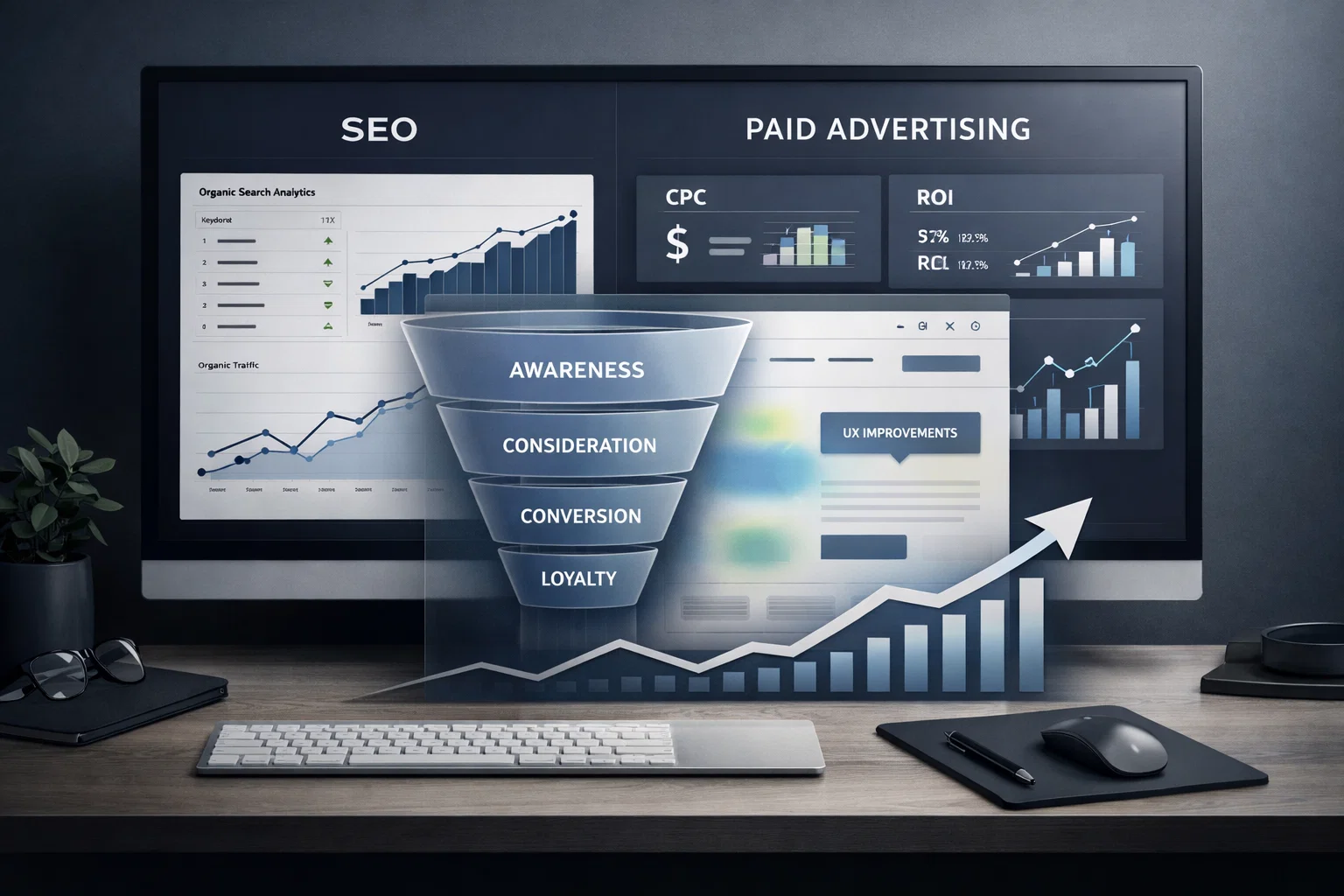
The Funnel Perspective
A smart marketing funnel doesn’t rely on one traffic source.
Instead, it:
- Uses SEO to attract intent-driven traffic
- Uses paid ads to accelerate reach
- Uses automation to nurture leads
- Uses retargeting to recover lost prospects
- Uses analytics to optimize continuously
If you’re evaluating structured growth implementation, reviewing comprehensive digital services can help you understand how both channels integrate into a unified strategy.
Common Mistakes Businesses Make
❌ Treating SEO and paid ads as competitors
❌ Running paid ads without conversion optimization
❌ Investing in SEO without technical tracking
❌ Ignoring retargeting
❌ Scaling ads before profitability
A digital marketing strategy comparison is only useful when tied to business goals.
Sustainable Growth Requires Systems
Sustainable growth is not about channel selection.
It’s about system integration.
The most successful businesses:
- Build SEO foundations
- Use paid ads strategically
- Automate follow-ups
- Track performance deeply
- Optimize continuously
When channels support each other, growth becomes predictable.
Final Thoughts
The debate between SEO vs paid ads is often framed incorrectly.
It’s not about which is better.
It’s about which serves your stage of growth.
SEO builds long-term visibility.
Paid advertising accelerates short-term results.
Automation and optimization create scalability.
A hybrid, data-driven approach drives sustainable growth.
If your marketing feels inconsistent, the issue may not be channel selection — it may be lack of integration.
Build systems.
Align channels.
Optimize continuously.
That’s how sustainable growth is engineered.