
Every business wants more leads. More sales. More growth.
But here’s the truth: traffic alone doesn’t scale revenue. A high-performance marketing funnel does.
If your business is generating traffic but struggling with inconsistent conversions, the problem is rarely visibility — it’s structure. A well-built marketing funnel transforms attention into predictable results. It guides prospects from awareness to action using strategy, psychology, and optimization.
In this guide, we’ll break down how to build a marketing funnel that converts consistently — not occasionally.
What Is a Marketing Funnel?
A marketing funnel is the structured journey a prospect takes from first interaction to final conversion.
It’s not just a landing page.
It’s not just ads.
It’s a connected system.
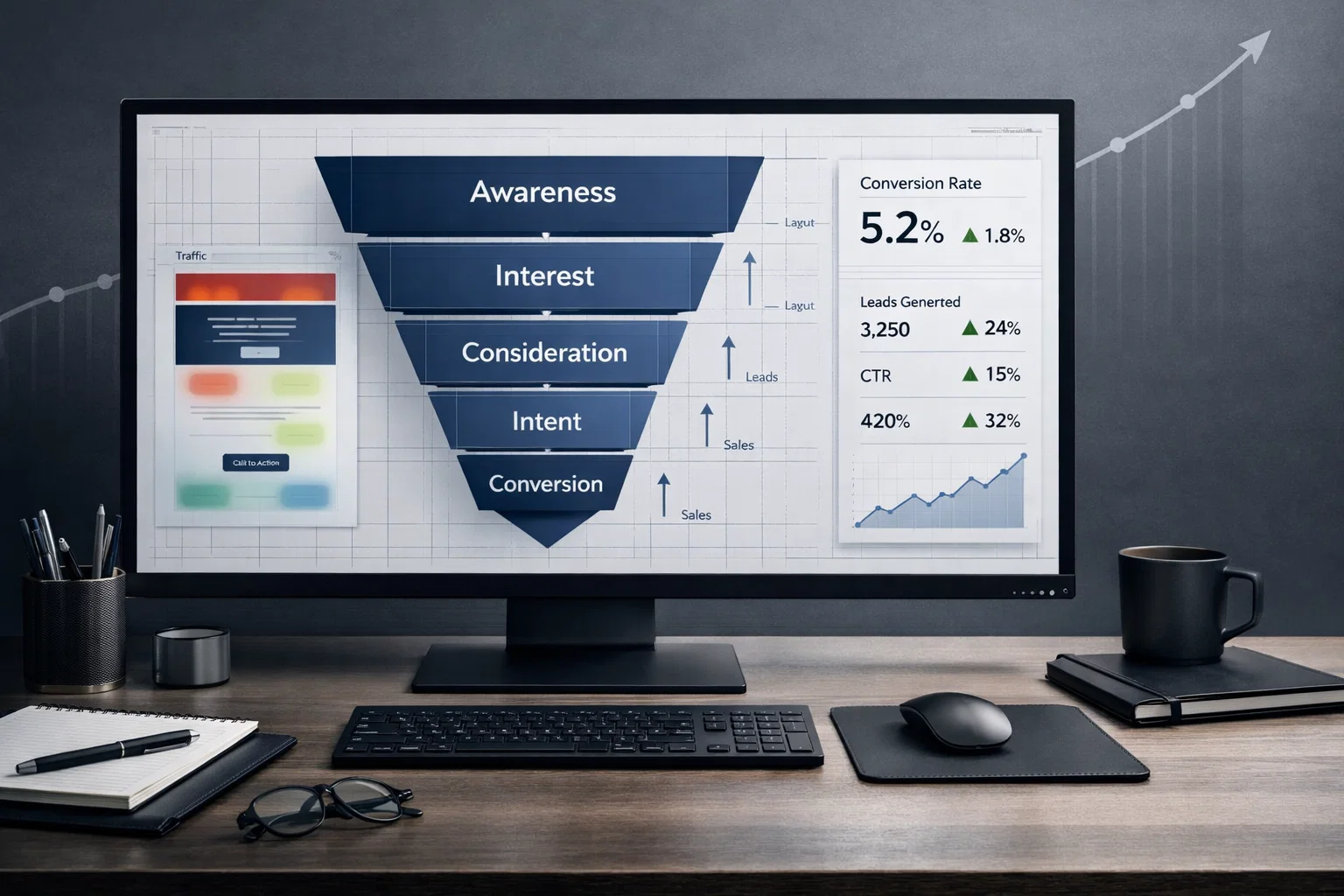
A conversion funnel typically includes:
- Awareness
- Interest
- Consideration
- Conversion
- Retention
High performance marketing focuses on optimizing each stage instead of relying on luck at the bottom of the funnel.
Why Most Funnels Fail
Most businesses build incomplete funnels.
They run ads without optimizing landing pages.
They collect leads without nurturing them.
They track clicks but ignore behavioral signals.
The result? Inconsistent performance.
A funnel fails when:
- There’s no clear messaging hierarchy
- The value proposition isn’t strong
- Follow-ups are manual or delayed
- There’s no data visibility
- Optimization is reactive
A high-performance funnel removes these weaknesses.
The 5 Core Layers of a High-Performance Marketing Funnel
1️⃣ Strategic Awareness Layer
The first step in any marketing funnel is visibility — but strategic visibility.
Awareness should be targeted, not broad. High performance marketing uses data-driven audience segmentation to reach high-intent prospects instead of random impressions.
This includes:
- Search-based targeting
- Interest segmentation
- Behavioral targeting
- Lookalike modeling
- Contextual placement
The goal isn’t maximum traffic.
It’s relevant traffic.
When awareness is precise, downstream conversion rates improve automatically.
2️⃣ Conversion-Focused Landing Architecture
Once someone clicks, your landing page becomes the most important asset in the funnel.
A high-converting page includes:
- Clear headline with value promise
- Strong subheading
- Focused call-to-action
- Minimal distractions
- Social proof
- Risk reduction elements
High performance marketing treats landing pages as engineered conversion environments — not generic web pages.
Small adjustments in layout, copy clarity, form fields, and button placement can significantly improve performance.
This is where conversion rate optimization (CRO) becomes critical.
3️⃣ Automated Lead Nurturing
Many funnels break after the form submission.
Leads go cold because there is no structured follow-up.
A high-performance marketing funnel includes automated nurturing:
- Instant confirmation messages
- Email sequences
- Retargeting campaigns
- CRM automation workflows
- Behavior-triggered communication
Marketing automation ensures no opportunity is wasted. It builds trust, educates prospects, and increases conversion probability over time.
Consistency creates momentum.
4️⃣ Intelligent Retargeting Layer
Not every prospect converts immediately. That’s normal.
Retargeting allows you to re-engage visitors who:
- Viewed a page but didn’t convert
- Opened emails but didn’t click
- Added items but abandoned checkout
- Spent time but didn’t take action
High performance marketing integrates retargeting into the conversion funnel to recover lost opportunities.
Instead of starting from zero each time, you build layered engagement.
5️⃣ Data-Driven Optimization
A funnel is never finished.
Continuous optimization is what transforms an average funnel into a scalable growth engine.
This includes:
- A/B testing headlines
- Testing CTAs
- Refining audience targeting
- Adjusting offers
- Improving page load speed
- Analyzing drop-off points
Every improvement compounds.
Without analytics, you’re guessing.
With data, you’re engineering growth.
The Psychology Behind a High-Converting Funnel
Beyond structure, psychology matters.
A strong marketing funnel addresses:
- Attention
- Trust
- Urgency
- Authority
- Simplicity
If prospects feel confused, they leave.
If they feel uncertain, they hesitate.
If they feel understood, they convert.
High performance marketing aligns messaging with buyer intent at every stage.
The Role of AI in Modern Conversion Funnels
AI-powered marketing tools elevate funnel performance by:
- Predicting user behavior
- Optimizing ad bids automatically
- Personalizing content
- Automating segmentation
- Scoring lead quality
Instead of manual guesswork, AI models analyze patterns and improve outcomes continuously.
When combined with automation, AI transforms a simple marketing funnel into a scalable revenue system.
If you want to understand how structured services can support full funnel architecture, exploring comprehensive digital growth solutions can clarify what’s possible.
Funnel Metrics That Actually Matter
Many businesses track vanity metrics.
High performance marketing tracks:
- Cost per qualified lead
- Conversion rate
- Customer acquisition cost
- Return on ad spend
- Lead-to-sale ratio
- Funnel drop-off rate
These metrics determine whether your funnel is profitable — not just active.
Common Funnel Mistakes to Avoid
Here are the most frequent conversion funnel errors:
❌ Too many CTAs on one page
❌ Slow loading pages
❌ Weak headline clarity
❌ No follow-up automation
❌ No retargeting strategy
❌ Lack of tracking integration
❌ Sending cold traffic directly to complex offers
A funnel must guide, not overwhelm.
Scaling a High-Performance Marketing Funnel
Once your funnel converts consistently, scaling becomes easier.
Scaling requires:
- Increased qualified traffic
- Stable conversion rates
- Automated lead processing
- Clear reporting dashboards
- Budget optimization
If the system works at 100 leads, it should work at 1,000.
That’s the power of structured high performance marketing.
If you’re ready to evaluate structured growth plans or explore funnel implementation strategy, reviewing detailed plan options or requesting a tailored strategy consultation can help determine your next step.
Final Thoughts
A high-performance marketing funnel is not about tactics. It’s about systems.
It combines:
- Targeted acquisition
- Conversion architecture
- Automated nurturing
- Retargeting intelligence
- Data-driven optimization
When each layer is connected, growth becomes predictable.
And predictable growth is scalable growth.
If your current marketing efforts feel inconsistent, the issue may not be effort — it may be structure.
Build the system.
Optimize continuously.
Scale confidently.